Process

Our Striping Process

Parking lot striping machine and crew equipment used for commercial pavement markings

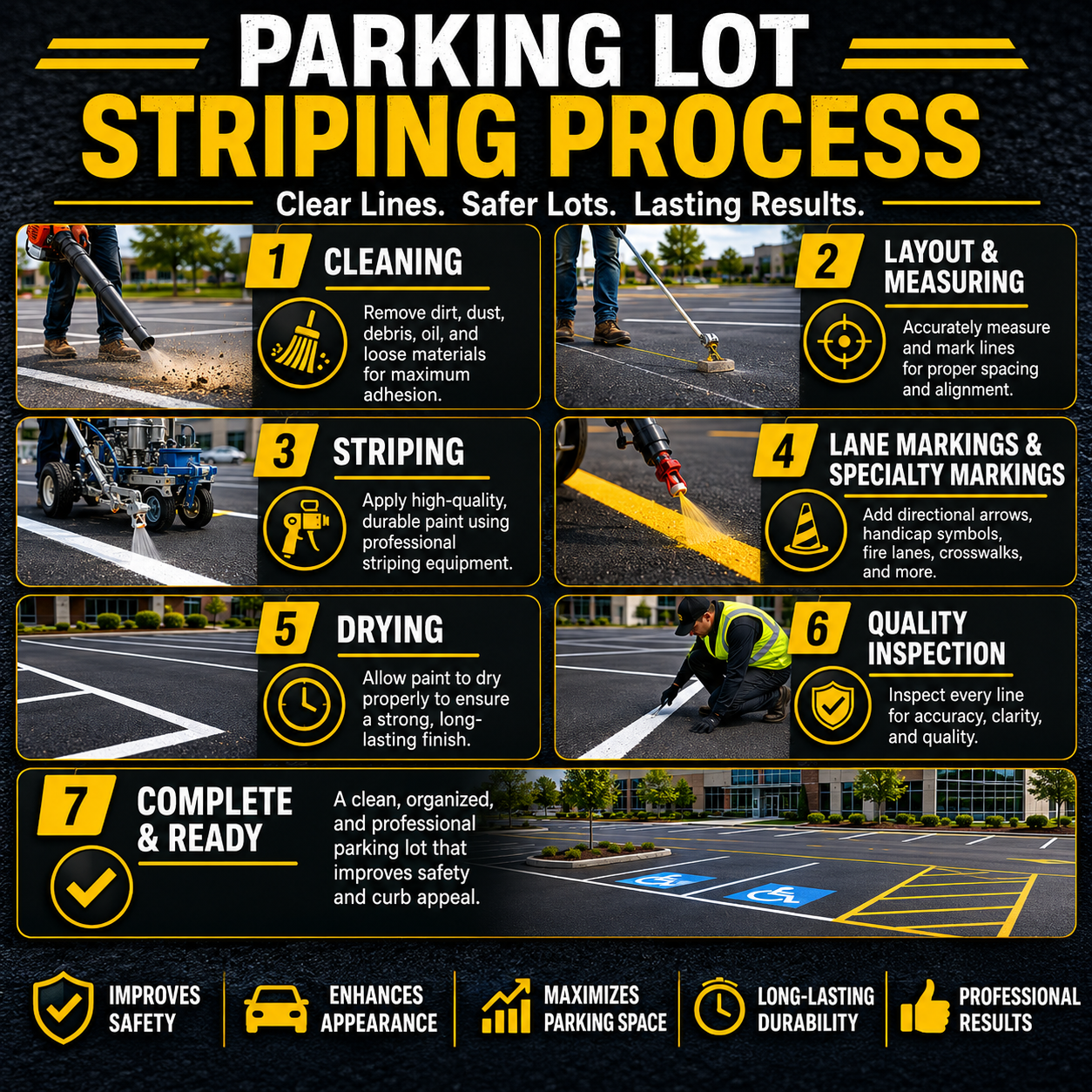
A clean striping job starts before paint hits the pavement. The lot has to be measured, traffic has to be considered, and the surface needs to be ready for paint to bond in Mississippi heat and humidity.

How a Typical Job Moves

  1. Site walkthrough: We look at entrances, drive aisles, ADA spaces, fire lanes, loading zones, pedestrian paths, drainage, pavement texture, and active traffic.
  2. Measurements: Stall widths, aisle dimensions, access aisles, wheel stop spacing, crosswalks, and stencil locations are measured against the usable pavement.
  3. Layout planning: We confirm traffic direction, tenant access, closure sequence, and whether the lot should be striped in phases.
  4. Surface prep: Loose debris, moisture, and problem areas are addressed before painting.
  5. Chalk layout: Critical lines, stencils, and arrows are chalked so spacing problems are caught early.
  6. Striping application: Lines, arrows, ADA symbols, curbs, fire lanes, and stencils are applied with attention to paint thickness, overspray, and alignment.
  7. Drying and curing: Reopening depends on heat, humidity, shade, airflow, and paint type.
  8. ADA verification: Accessible stalls, access aisles, symbols, and routes are checked against the agreed layout.
  9. Final inspection: We walk the job, remove cones when safe, and note any areas that need touch-up.

Process

Walkthrough, measurements, chalk layout, prep, paint, curing, and final inspection.

ADA Guide

Access aisles, signage, fire lane visibility, and common marking issues.

Layout Planning

Traffic flow, pedestrian safety, loading zones, apartments, and retail layouts.

Call Now